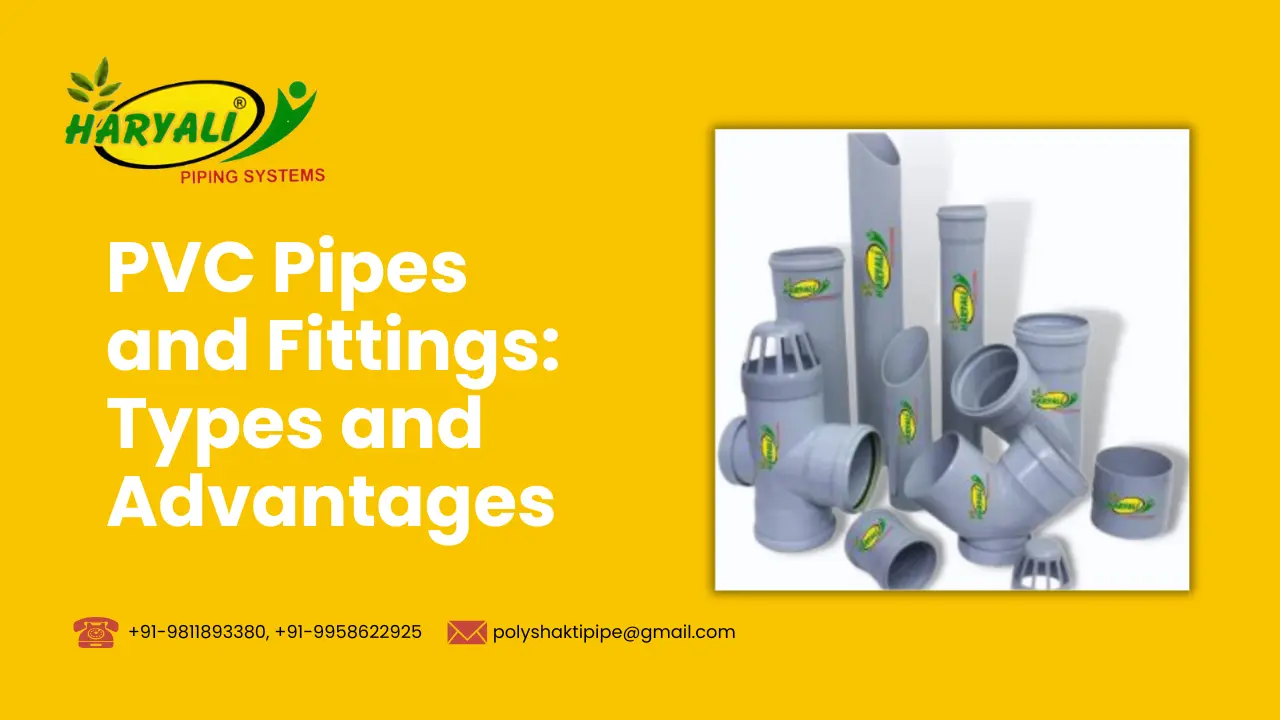
PVC pipes have become an essential part of modern plumbing, agriculture, and industrial infrastructure. However, pipes alone cannot create an efficient pipeline system. The real strength of any piping network lies in the PVC pipe fittings used to connect, redirect, or control the flow of water or other fluids. Understanding the types of PVC pipe fittings helps engineers, contractors, and end users choose the right components for durability, leak-proof performance, and long service life.
At Polyshakti Pipe Industries, we manufacture high-quality PVC pipe fittings that meet industry standards and perform reliably across residential, commercial, and industrial applications. In this blog, we will explain different PVC pipe fittings names, PVC pipe joint types, and PVC coupling types in a simple and practical way.
What Are PVC Pipe Fittings?
PVC pipe fittings are specially designed components used to connect PVC pipes, change direction, regulate flow, or terminate pipe ends. These fittings are made from Polyvinyl Chloride, a lightweight yet strong plastic material known for corrosion resistance, chemical stability, and cost-effectiveness.
PVC pipe fittings are widely used in water supply systems, drainage lines, irrigation networks, chemical pipelines, and industrial fluid transport. Their easy installation and low maintenance make them a preferred choice over traditional metal fittings.
Importance of Choosing the Right Types of PVC Pipe Fittings
Selecting the correct type of fitting is crucial for ensuring system efficiency and safety. Incorrect fittings may lead to leakage, pressure loss, or frequent maintenance. Understanding the types of PVC pipe fittings ensures proper alignment, strong joints, and long-term performance of the pipeline.
Different applications require different fittings based on pressure rating, pipe diameter, flow direction, and installation environment.
Common PVC Pipe Fittings Names and Their Uses
There are many PVC pipe fittings names used in plumbing and industrial systems. Each fitting serves a specific purpose and plays a vital role in pipe connectivity.
- PVC Elbow Fittings- PVC elbows are used when the pipeline needs to change direction. These fittings are commonly available in 45-degree and 90-degree angles. Elbows are essential in residential plumbing where space constraints require directional changes without bending the pipe.
PVC elbow fittings are widely used in drainage systems, water supply lines, and irrigation pipelines. - PVC Tee Fittings- PVC tee fittings allow the pipeline to split into two directions. They are shaped like the letter “T” and are used where fluid needs to be distributed to multiple lines. Tee fittings are common in water distribution systems, agriculture irrigation, and industrial fluid networks.
- PVC Cross Fittings- PVC cross fittings connect four pipes at one point. Although less commonly used than tees, they are useful in complex pipeline layouts where multiple branches are required. These fittings are typically used in industrial and specialized plumbing systems.
- PVC Reducer Fittings- Reducer fittings are used when pipes of different diameters need to be connected. They help regulate flow and pressure by gradually reducing pipe size. Reducers are very common in industrial pipelines and pump connections.
Understanding PVC Pipe Joint Types
PVC pipe joint types define how pipes and fittings are connected together. Choosing the correct joint type is essential for leak prevention and structural stability.
- Solvent Cement Joint- This is the most common PVC pipe joint type. In this method, a special PVC solvent cement is applied to the pipe and fitting, creating a chemical bond. Once cured, the joint becomes strong and leak-proof. Solvent cement joints are widely used in plumbing, drainage, and irrigation systems.
- Threaded Joint- Threaded joints are used where disassembly may be required in the future. These joints have internal or external threads and are often used in water tanks, valves, and pump connections. Threaded joints are common PVC pipe joint types in maintenance-heavy systems.
- Rubber Ring Joint- Rubber ring joints use an elastomeric seal to connect pipes without solvent cement. These joints allow slight movement and expansion, making them suitable for underground drainage and sewage systems.
Different PVC Coupling Types Explained
Couplings are among the most commonly used PVC pipe fittings. They are used to join two pipes together in a straight line.
- Plain PVC Coupling- Plain couplings are used to connect two pipes of the same diameter permanently using solvent cement. This is one of the simplest and most widely used PVC coupling types.
- PVC Reducing Coupling- Reducing couplings connect pipes of different diameters. These are commonly used in systems where flow control or size transition is required.
- PVC Repair Coupling- Repair couplings are designed to fix damaged or broken pipelines without replacing the entire section. They are extremely useful for quick maintenance and emergency repairs.
- Threaded PVC Coupling- Threaded couplings are used where pipes need to be connected and disconnected multiple times. These PVC coupling types are often used in industrial and mechanical systems.
Applications of PVC Pipe Fittings
PVC pipe fittings are used across a wide range of industries. In residential plumbing, they ensure smooth water supply and drainage. In agriculture, PVC fittings form the backbone of irrigation and sprinkler systems. Industrial applications include chemical transport, effluent treatment plants, and process pipelines.
Due to their corrosion resistance, PVC pipe fittings are ideal for both indoor and outdoor installations. Their lightweight nature also reduces transportation and installation costs.
Advantages of Using PVC Pipe Fittings
PVC pipe fittings offer numerous benefits that make them a preferred choice across industries. They are resistant to rust, chemicals, and moisture, ensuring long service life. Their smooth inner surface minimizes friction loss and improves flow efficiency.
Additionally, PVC pipe fittings are easy to install, require minimal maintenance, and are cost-effective compared to metal alternatives. These advantages make them suitable for long-term infrastructure projects.
How to Select the Right Types of PVC Pipe Fittings
Choosing the right PVC pipe fittings depends on pipe size, pressure requirements, application type, and joint method. It is important to consider whether the system needs permanent or removable joints, and whether it will be exposed to chemicals, sunlight, or high pressure.
At Polyshakti Pipe Industries, our experts help customers select the most suitable PVC pipe fittings names and PVC pipe joint types based on their project requirements.
Get PVC Pipe & Fitting From Polyshakti Pipes
Polyshakti Pipe Industries is a leading manufacturer of high-quality PVC pipes & fittings designed to meet Indian and international standards. Our products are manufactured using premium raw materials and advanced production techniques to ensure strength, precision, and durability.
We offer a wide range of PVC pipe fittings types and sizes, and customized solutions for various industries. Our commitment to quality and customer satisfaction makes us a reliable partner for all piping needs.
Conclusion
Understanding the types of PVC pipe fittings is essential for building an efficient, safe, and long-lasting piping system. From common PVC pipe fittings names to advanced PVC pipe joint types and PVC coupling types, each fitting plays a vital role in pipeline performance.
By choosing the right fittings and trusted manufacturers like Polyshakti Pipe Industries, you ensure durability, efficiency, and peace of mind for your plumbing or industrial project. PVC pipe fittings are not just connectors—they are the foundation of a reliable pipeline system.